A Simple Winter Ritual, A Moment of Reflection

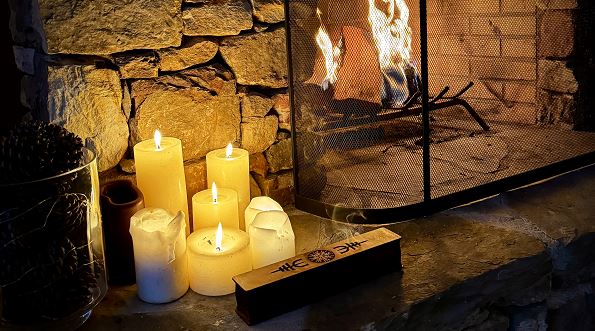
In the deep heart of winter, when the days are short and the world feels wrapped in a quiet hush, a small ritual can become an anchor. One of the simplest and most powerful is the act of lighting a candle and reflecting on nature. Whether you walk a Druid path, another spiritual tradition, or none at all, this gentle practice offers a moment of stillness in a season that can feel heavy and inward-turning.

The flame of a simple candle is a reminder of continuity. In January the sunlight is scarce and the earth lies dormant. Lighting a candle becomes an affirmation that warmth and life still exist beneath the surface. Many people find that this small gesture helps them reconnect with their own inner spark, the part that remains steady even when the world around them feels cold or chaotic.

Pairing the candle with a nature reflection deepens the effect and doesn’t require an elaborate meditation. Sit for a few minutes, perhaps with a cup of warming tea, and consider something from the natural world: the patience of bare trees outside the window, the resilience of winter birds at the feeder, or the quiet strength of mountains. You might reflect on your own relationship to these qualities, what nature is teaching you right now, and where you feel called to grow when the light returns.

Extending this as a weekly practice throughout the year could be a powerful way to create a meditative rhythm in your life. Amid busy schedules, a recurring moment of return can steady the mind and soften the spirit. Over time, this small ritual becomes a marker in the week: a pause, a breath, a reminder that you belong to something larger and older than any single season.

In the cold months, tending a small flame and a small reflection can be a way of tending yourself quietly and with a sense of belonging to the living world.

/|\ SeanR, Druid

Welcoming the Winter Solstice

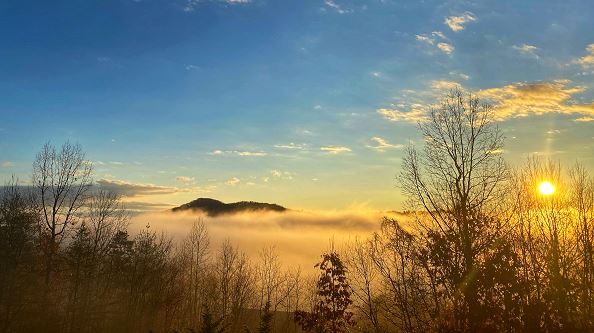
A winter sunrise in the Blue Ridge Mountains of North Carolina.
A winter sunrise in the Blue Ridge Mountains of North Carolina. ©SeanR 2025

At the Winter Solstice—Alban Arthan, the “Light of Arthur”—the year reaches its deepest stillness. This is the longest night, the moment when the sun appears to stand still on the horizon before beginning its slow climb back toward fullness. For modern Druids, this turning is not only astronomical but profoundly symbolic. It speaks of renewal, endurance, and the quiet strength found in rest. It is a time when in the dark earth seeds are held safe and new beginnings take shape.

Druid celebrations, including our own here at Awen’s Light Grove, center on acknowledging both darkness and returning light. Some will gather before dawn to witness sunrise, and light a fire or candle to greet the newborn sun. Rituals may include storytelling, blessings of the hearth, reflection on the past year, and setting intentions for the one to come. While there can be grand ceremonies at this time of year, for many Druids it is more of a reflective time about presence, gratitude, and inner listening.

Humanity has been honoring this threshold for thousands of years. At Newgrange in Ireland, the rising solstice sun pierces the passage and illuminates the inner chamber with a golden beam—a feat of engineering and devotion older than Stonehenge and the pyramids. Stonehenge itself aligns with the solstice sunrise, while Maeshowe in Orkney frames the sunset. These sites remind us that the returning light has always mattered, anchoring communities to seasonal rhythms long before written history.

You don’t need to be a Druid to celebrate meaningfully. Wake early and watch the dawn. Light a single candle and reflect on what you’re ready to release and what you hope to nurture. Take a winter walk, noticing how the land rests and restores itself. Prepare a warm meal, share stories, or create a small moment of beauty in your home. However you observe the Winter Solstice the Druids of Awen’s Light Grove invite you to pause, breathe, and remember that even in the darkest night, the promise of light is already on the horizon.


/|\ SeanR, Druid

A Druid’s Path

Deciding to explore the Druid Path has been life enhancing while also challenging. As with any adventure or travel, I was excited and curious about what I would encounter.  I was wandering into territory which held familiarity as well as mysteries.  There would be open meadows and dark forests, mountains and valleys, there would be challenges which were intellectual, physical and emotional.  And it would be a much longer journey than I had imagined.  In fact, the mysterious and magical journey continues even after completing the Druid level program.

The Order of Bards, Ovates and Druids independent study program is not bound by a strict calendar.  Once enrolled in the course, the student proceeds at their own pace.  A very disciplined new Bard could finish the course in a year.  Most of us take much longer.  Exploring the mysteries of one’s self, one’s relationship to the elements, to seasons, to myths that inform us of history and ethics are relevant for modern Druids.  The Bard level sets the Druid student on their path. 

Out of deep respect for the journey and one another OBOD Druids do not discuss the specifics of the course.  There is support for each individual to have their own discoveries without knowing the “territory ahead”.  Acknowledging we are each engaged in a “mystery school” and that our discoveries and insights are our own is held in sacred trust.  OBOD provides qualified mentors to serve as guides, as needed, for each enrollee.  Since there are always questions that arise, creating a contact to whom you can direct questions is valuable.  These communications are usually via email unless the mentor and/or student prefer another method.

Awen’s Light Grove follows the Order of Bards, Ovates and Druids ceremonies for the eight festivals that mark the wheel of the year.  Using the OBOD ceremony reminds us we are part of something much bigger than our local grove.  All over the globe there are fellow Druids following the same ritual, holding the same intentions for the good of the planet and all inhabitants.  Each individual and grove are weaving an interlacing magic.

If you love nature and it’s mysteries, if you want to know yourself more deeply, if you want to engage in supporting the web of connections with other beings (human and otherwise) you may find an enriching experience in enrolling in OBOD.  Awen’s Light Grove members look forward to sharing the journey with you.

The Big Tent of Paganism

January 11, 2015 by John Beckett. Read his blog “Under the Ancient Oaks” and this post here

I like a “Big Tent” approach to Paganism.  Druids and Wiccans, Heathens and Hellenists, Thelemites and chaos magicians, shamans and seers, kitchen witches and tree huggers – there’s room for everyone.

What do all these people have in common, you ask?  Not a single thing.

But there’s still value in the Big Tent of Paganism.

photo courtesy of shutterstock

Imagine, if you will, a huge circus tent.  It’s supported by four large poles.  These are the four centers of Paganism:  Nature, the Gods, the Self, and Community.  To continue the circus metaphor, these aren’t rings you’re either inside or outside of, these are poles you’re closer to or farther away from.  Some Pagans are so close to one pole (center) they’re hugging them – they don’t care about the other three centers.  Others are close to two or three or even all four centers.

I’m primarily a Nature and Deity centered Pagan.  My love of hills and trees, the sun and the moon and the night sky, and my study of science brought me here.  My experience of the Gods gives me depth and meaning.  Read through this blog and you’ll see these are my primary concerns.

I have some interest in the Self – in refining my soul and improving my skills so as to be of greater service to the world.  I have some interest in Community – in building vibrant groups and resilient institutions to support our Great Work.  But while those are important, I don’t have the passion for them that I have for Nature and the Gods.

Now, imagine this tent has lots of people moving around in it.  Some are crowded tightly around one pole.  Others bounce from pole to pole to pole.  Eventually, though, most people find a spot they’re comfortable with, and they discover they’re not alone – there are others who have the same interests and passions.  Sometimes there’s already an organized tradition at that spot in the tent: say, Gardnerian Wicca or OBOD Druidry.  Sometimes there’s an informal gathering, like traditional witchcraft.  Other times there’s nothing and people decide to create a group, like the Coru Cathubodua priesthood of the Morrigan.  And some people insist on standing by themselves.

The flaps of this tent are up – there’s nothing to stop people from wandering in and out.  Some people find a gathering spot outside the tent.  Green Christians have a lot in common with Nature centered Pagans, but they aren’t inside our tent.  The Afro-Caribbean religions have varying degrees of Catholicism in them, but they’re generally considered to be in the tent.  What about Hinduism?  Some Hindus say they’re in, other Hindus insist they’re out.

There are no fences and there are no guards.  If you want to come in, you can come in.  If you want to go out, you can go out.  I prefer the biggest of Big Tents, but ultimately each group and each individual has to decide if they’re Pagan or not.

“If a word doesn’t have a clear meaning then it doesn’t mean anything at all!”  I hear this all the time and I strongly disagree – this argument is adolescent pedantry.  Paganism can’t be precisely defined because it doesn’t have boundaries – you aren’t in or out.  You’re closer to or farther from the four centers, and if you’re close enough to one or more of the centers to be inside the Big Tent, you’re a Pagan.

Our troubles with the term largely stem from the ideas that one tradition is normative of Paganism and that there are certain elements of belief and practice that are essential to Paganism.  Neither of these assumptions are correct.  Wiccan concepts and rituals are by far the most common, but all that means is that there are more people in the Wiccan area of the Big Tent.

When some polytheists insist “I’m not Pagan” what they’re usually saying is “my religion has nothing to do with the Wiccanish stuff all those folks are doing.”  That’s true, but as I see it they’re standing right beside the pole labeled “Gods” and that puts them clearly inside the Big Tent.

The reality is that the volume of Paganism is at a high, vague, Wiccanish / witchcraft level.  The depth is being developed at a very focused, very intense level. Interestingly, much of that is happening in witchcraft.  The fact that many people are practicing at a superficial level doesn’t stop others from practicing that same tradition very deeply.  It’s clear that as people settle into an area of the Big Tent, they soon find “Pagan” no longer completely describes what they do.

If a random person on the street asks me what I am, I may say I’m a Pagan.  If someone at Pagan Pride Day asks, I’ll say I’m a Druid.  If someone at a retreat asks, I’ll say I’m a polytheist Druid pledged to Cernunnos and Danu who worships many of the Celtic deities and occasionally others.

All of those labels are accurate and all are a helpful way to communicate, depending on the audience.

The Big Tent provides a visible, easy-to-find entry point for ordinary people who are looking for something their current religion isn’t providing.  And it makes it much easier for us to find others inside the tent who are doing the same things for the same reasons.

There may be nothing that is common to 100% of Pagans, but we have plenty of similar interests.  Almost all of us are concerned with promoting and protecting religious freedom and preventing the establishment of a majority religion.  Many of us are concerned with respecting Nature and caring for the environment, whether or not we believe the Earth is the body of a Goddess.  Many honor our ancestors, whether we pour libations to them or study their history or strive to live by their values.

overlapping circlesDraw circles around our groups and no one circle will include us all, but there’s lots and lots of overlap in our beliefs, practices, interests, and concerns – enough overlap to create and support things like Pagan Pride Day, Pantheacon, Patheos Pagan, The Wild Hunt, and Pagan music.  Individually, no one tradition is big enough to support these large endeavors.  Together we can.

We are not one.  There is no single Pagan religion and I have no desire to create one.  But the Big Tent of Paganism is a useful and beneficial approach to grow and support our many Pagan religions.


Why I’m An OBOD Druid

-By John Beckett
http://www.patheos.com/blogs/johnbeckett/

Over the past few weeks I’ve had multiple people ask me to tell them about OBOD: the Order of Bards, Ovates and Druids. Most are considering joining the Order and just as I did before I signed up, they want to pick the brain of someone who’s been there and done that. I’ve answered the individual questions, but there are probably others… which means it’s time to blog about it.

Like many people, I came into Paganism through Wicca. I wanted to be a Witch and I tried to be a Wiccan but it just wasn’t a good fit for me. But when I first read about Druidry, something clicked. This wasn’t something that looked interesting and cool – this was who I am. I didn’t choose Druidry, Druidry chose me.

Unfortunately, there were no Druid groves anywhere near me. When I realized I needed a group, I went to check out Denton CUUPS, and that was a good fit. Before long I found myself in a leadership role… a role I didn’t feel qualified to fill.

I knew I needed some training and I wanted training in Druidry. After some investigation and reflection, I signed up for the Bardic course of the Order of Bards, Ovates and Druids. I completed the Bardic course in 15 months, the Ovate course in 25 months, and the Druid course in 24 months. My certificate proclaiming me “a full member in the Druid grade” hangs on the same wall with my high school, college, and graduate diplomas.

That’s the “what” – it’s a story I’ve told many times. But the question of “why” remains – why do I still identify as an OBOD Druid when my current practice is focused on devotional polytheism?

OBOD Chosen Chief Philip Carr-Gomm

OBOD has an excellent distance learning program. There’s nothing quite like learning at the feet of an experienced, knowledgeable elder, and there are some traditions that teach no other way. The problem is finding an experienced, knowledgeable elder who isn’t already teaching more students than she can handle. Other traditions have distance learning and individual study programs and some of them are good – and in the end, no matter what kind of training program you follow, you have to do the work.

OBOD’s program is simply the best I’ve seen. Historian Ronald Hutton has said the OBOD course “arguably represents one of the major documents of British spirituality from the late twentieth century.” Practiced diligently, it can enable a motivated student to grow from knowing virtually nothing to becoming a competent Druid practitioner in a few years.

The downside of the OBOD program is the cost. The current price of the Bardic course is £215, which is $348 at today’s exchange rates. The other courses are similarly priced. Keep in mind this doesn’t just represent the cost of the lesson booklets – it’s how the Order supports itself. There are no other membership fees. It sounds like a lot, but how much do you spend on cable TV? When people balk at the cost, I have one recommendation: if the cost represents a hardship, don’t do it. If the cost represents a sacrifice, do.

OBOD provides a grounding in historical Druidry. What we know about the original Druids is inspirational, but there simply aren’t enough facts to build a practice around it. But history doesn’t jump from the Anglesey massacre in 61 CE to Ross Nichols and Isaac Bonewits in the second half of the 20th century. Druids never really left the collective imagination of the British Isles and while the 1717 date Nichols claimed for the founding of the order that would lead to OBOD is likely more mythical than historical, it is certain there were Druid orders operating in the 18th century.

These Revival Druids were not Pagans. But they laid the foundations for today’s mostly-Pagan Druidry, and they contributed non-orthodox ideas to the Christian culture – ideas that would influence the early modern Pagan movement. The Revival Druids are our spiritual ancestors. They deserve our respect and their ideas deserve our consideration.

OBOD provides a foundation and a framework for Pagan practice. Although OBOD is a non-creedal and non-doctrinal order, most of its material is presented in a Pagan context. It has roots in the Western Mystery Tradition: OBOD ritual casts circles, calls directions, and works with the four (or five) elements. It works with Gods and Goddesses, honors sacred sites, and emphasizes the sacredness of Nature. It celebrates the Wheel of the Year.

OBOD founder Ross Nichols was a friend and sometimes editor of Gerald Gardner, founder of Wicca. There is a story (that may or may not be true) that says Gardner originally wanted to celebrate the four solar holidays and Nichols wanted to celebrate the four Celtic fire festivals. They combined the two to create the modern Pagan calendar.

I found much that was familiar when I worked through the early Gwersi (lesson booklets), but I don’t think there was a single one where I didn’t learn something new. I wanted training to help lead a Pagan group and I found what I wanted.

House of Danu Gorsedd - 2009

OBOD provides connections and community. It is possible to move through the three grades and never interact with another Druid beyond your assigned mentors, who monitor progress and answer questions (of a factual nature – requests for interpretation are usually answered with “what do you think?”). Many OBOD members do exactly this.

But despite the lack of a local grove, I’ve made many personal connections at OBOD camps and through social media. More than a few of these connections have become deep friendships. I’ve also met Druids from other orders at OBOD events and through OBOD connections.

The training and education brought me into OBOD. The friendships I’ve made within the Order keep me active in OBOD.

Spiritual depth. It is possible to spend a lifetime studying the lessons of the three grades, practicing the meditations, performing the rituals, and participating in this-world activities they inspire. I know some OBOD Druids who do this, and if that works for you I recommend it. There is great depth in the teachings of the Order.

But while this approach would be very Nature-centered and Self-centered, it wouldn’t be very Deity-centered. This is why, ultimately, OBOD isn’t enough for me. Polytheism is an essential part of my religious and spiritual life and while OBOD is compatible with polytheism, it doesn’t emphasize it. My interactions with the Gods and my relationships with Them require a level of devotion OBOD doesn’t teach.

That doesn’t mean there’s anything wrong with OBOD – it just means OBOD, by itself, isn’t enough for me. But the spiritual techniques it taught me have been very helpful in exercising that devotion.

There are many fine Druid orders and I have friends in several. Honestly, I don’t know any Druid orders I’d recommend you avoid. If I had unlimited time I’d probably join one or two more just to see what I could learn from them. There is no “best” Druid order, just different orders that fit individuals very well or not so well. If you feel called to Druidry, do some on-line investigation, read a few books, talk to some people who have first-hand experience, and make the best choice for you.

This is why I’m an OBOD Druid.

Read more: http://www.patheos.com/blogs/johnbeckett/2014/10/why-im-an-obod-druid.html#ixzz3F82GRiK6