Written by Isaac Bonewits
The Ancient Celtic Fire Festivals
There appear to have been four major holy days celebrated by the Paleopagan Druids, possibly throughout the Celtic territories: Samhain, Oimelc, Beltane & Lughnasadh (in one set of Irish-based modern spellings). Four additional holy (or “High”) days (Winter Solstice or “Midwinter,” Spring Equinox, Summer Solstice or “Midsummer,” and Fall Equinox), which are based on Germanic or other Indo-European cultures, are also celebrated in the Neopagan Druid calendar, along with others based on mainstream holidays (visit the linked essay for details).
The most common practice for the calculation of Samhain, Oimelc, Beltane and Lughnasadh has been, for the last several centuries, to use the civil calendar days or eves of November 1st, February 1st, May 1st and August 1st, respectively. Since we have conflicting evidence on how the Paleopagan Druids calculated these dates, modern Neopagans just use whichever method is most convenient. This means, of course, that we aren’t all doing anything uniformly on any given night, which fits perfectly with the Neopagan saying that, “organizing Pagans is like herding cats.” It doesn’t match the Evil Conspiracy theories — which have us all marching to a strict drumbeat in perfect Satanic unison — at all.
These four major holy days have been referred to as “fire festivals” for at least the last hundred years or so, because (1) to the ancient Celts, as with all the Indo-European Paleopagans, fire was a physical symbol of divinity, holiness, truth, and beauty; (2) fires play important roles in the traditional customs associated with these festivals; and (3) several early Celtic scholars called them that. Whether in Ireland or India, among the Germans or the Hittites, sacred fires were apparently kindled by the Indo-European Paleopagans on every important religious occasion. To this very day, among Eastern Orthodox and Western Catholics, you can’t have a satisfying ritual without a few candles being lit — of course, the Fundamentalists consider them Heathen too! Samhain or “Samhuinn” is pronounced “sow-” (as in female pig) “-en” (with the neutral vowel sound) — not “Sam Hain” — because “mh” in the middle of an Irish word is a “w” sound (don’t ask me why, it’s just Irish). Known in Modern Irish as Lá Samhna, in Welsh as Nos Galen-Gaeaf (that is, the “Night of the Winter Calends”), and in Manx as Laa Houney (Hollantide Day), Sauin or Souney, Samhain is often said to have been the most important of the fire festivals, because (according to most Celtic scholars) it may have marked the Celtic New Year. At the least, Samhain was equal in importance to Beltane and shared many symbolic characteristics.Samhain was the original festival that the Western Christian calendar moved its “All Saints’ Day” to (Eastern Christians continue to celebrate All Saints’ Day in the spring, as the Roman Christians had originally). Since the Celts, like many cultures, started every day at sunset of the night before, Samhain became the “evening” of “All Hallows” (“hallowed” = “holy” = “saint”) which was eventually contracted into “Hallow-e’en” or the modern “Halloween.”
Whether it was the Celtic New Year or not, Samhain was the beginning of the Winter or Dark Half of the Year (the seasons of Geimredh=Winter and Earrach=Spring) as Beltane was the beginning of the Summer or Light Half of the Year (the seasons of Samradh=Summer and Foghamhar=Fall). The day before Samhain is the last day of summer (or the old year) and the day after Samhain is the first day of winter (or of the new year). Being “between” seasons or years, Samhain was (and is) considered a very magical time, when the dead walk among the living and the veils between past, present and future may be lifted in prophecy and divination.
Many important mythological events are said to have occured on that day. It was on a Samhain that the Nemedians captured the terrible Tower of Glass built by the evil Formorians; that the Tuatha De Danann later defeated the Formors once and for all; and that many other events of a dramatic or prophetic nature in Celtic myth happened. Many of these events had to do with the temporary victory of the forces of darkness over those of light, signaling the beginning of the cold and dark half of the year.
There is some evidence to indicate that three days were spent celebrating this festival. Philip Carr-Gomm, Chosen Chief of the Order of Bards, Ovates and Druids, speaking of both Paleopagan and Mesopagan Druids in England, had this to say about it in his Elements of the Druid Tradition:
Samhuinn, from 31 October to 2 November was a time of no-time. Celtic society, like all early societies, was highly structured and organised, everyone knew their place. But to allow that order to be psychologically comfortable, the Celts knew that there had to be a time when order and structure were abolished, when chaos could reign. And Samhuinn, was such a time. Time was abolished for the three days of this festival and people did crazy things, men dressed as women and women as men. [This happened at Beltane too — IB] Farmers’ gates were unhinged and left in ditches, peoples’ horses were moved to different fields, and children would knock on neighbours’ doors for food and treats in a way that we still find today, in a watered-down way, in the custom of trick-or-treating on Hallowe’en.
But behind this apparent lunacy, lay a deeper meaning. The Druids knew that these three days had a special quality about them. The veil between this world and the World of the Ancestors was drawn aside on these nights, and for those who were prepared, journeys could be made in safety to the ’other side’. The Druid rites, therefore, were concerned with making contact with the spirits of the departed, who were seen as sources of guidance and inspiration rather than as sources of dread. The dark moon, the time when no moon can be seen in the sky, was the phase of the moon which ruled this time, because it represents a time in which our mortal sight needs to be obscured in order for us to see into the other worlds.
The dead are honoured and feasted, not as the dead, but as the living spirits of loved ones and of guardians who hold the root-wisdom of the tribe. With the coming of Christianity, this festival was turned into Hallowe’en (31 October), All Hallows [All Saints Day] (1 November), and All Souls Day (2 November). Here we can see most clearly the way in which Christianity built on the Pagan foundations it found rooted in these isles. Not only does the purpose of the festival match with the earlier one, but even the unusual length of the festival is the same.
The Christian Church was unable to get the people to stop celebrating this holiday, so they simply sprinkled a little holy water on it and gave it new names, as they did with other Paleopagan holidays and customs. This was a form of calendrical imperialism, co-opting Paleopagan sacred times, as they had Paleopagan sacred places (most if not all of the great cathedrals of Europe were built on top of earlier Paleopagan shrines and sacred groves). So when Fundamentalists come to your local school board and try to get Halloween removed from the public schools because “it’s a Pagan holiday,” they are perfectly correct. Of course, Valentine’s Day/Lupercalia, Easter/Eostre, and Christmas/Yule also have many Paleopagan elements associated with their dating and/or symbols, as the Jehovah’s Witnesses and others have pointed out for decades. So if we decide to rid the public schools of all holidays that have Pagan aspects to them, there won’t be many left for the kids to enjoy.
I find it amusing that American teens and pre-teens seem to have instinctively expanded their seasonal celebrations to add another night before Halloween, one on which they commit various acts of harmless (or unfortunately not) vandalism, including pranks on neighbors. If we assume that All Saints Day was moved to co-opt the central day of Samhain which was associated originally with the Gods and Goddesses of the Celts, and All Souls Day was supposed to co-opt the worship of the Ancestors, then the modern “Cabbage Night,” “Hell Night” (boy does that push the Fundamentalists’ buttons!), or simply “Mischief Night” (which used to be April 30th — the night before May Day — in Germany — there’s that Beltane/Samhain connection again) would correspond to a celebration of the often mischievous Nature Spirits. This then nicely covers the Indo-European pattern of the “Three Kindreds” of Deities, Ancestors, and Nature Spirits.
Trick or Treat
Where does the custom of “trick or treating” come from? Is it really ancient, a few centuries old, or relatively modern? Let’s look at the evidence:
Kevin Danaher, in his remarkable book The Year in Ireland, has a long discussion of the traditional Irish celebrations of this festival. In one section on “Hallow-E’en Guisers,” he says:
A familiar sight in Dublin city on and about October 31 is that of small groups of children, arrayed in grotesque garments and with faces masked or painted, accosting the passers-by or knocking on house doors with the request: “Help the Hallow E’en party! Any apples or nuts?” in the expectation of being given small presents; this, incidentally, is all the more remarkable as it is the only folk custom of the kind which has survived in the metropolis.
A couple of generations ago, in parts of Dublin and in other areas of Ireland, the groups would have consisted of young men and grown boys, who often travelled considerable distances in their quest, with consequently greater reward. The proceeds were usually expended on a “Hallow E’en party,” with music, dancing, feasting and so on, at some chosen house, and not merely consumed on the spot as with the children nowadays…
Irisleabhar na Gaedhilge, ii, 370, states that in parts of Count Waterford, Hallow E’en is called oidhche na h-aimléise, “The night of mischief or con.” It was a custom in the county — it survives still in places — for the “boys” to assemble in gangs, and, headed by a few horn-blowers who were always selected for their strength of lungs, to visit all the farmers’ houses in the district and levy a sort of blackmail, good humouredly asked for, and as cheerfully given. They afterward met at some rendezvous, and in merry revelry celebrated the festival of Samhain in their own way. When the distant winding of the horns was heard, the bean a’ tigh [woman of the house] prepared for their reception, and got ready the money or builín (white bread) to be handed to them through the half-opened door. Whoever heard the wild scurry of their rush through a farm-yard to the kitchen-door — there was always a race amongst them to get possession of the latch — will not question the propriety of the word aimiléis [mischief] applied to their proceedings. The leader of the band chaunted a sort of recitative in Gaelic, intoning it with a strong nasal twang to conceal his identity, in which the good-wife was called upon to do honour to Samhain… “A contributor to An Claidheamh Soluis, 15 Dec. 1906, 5, gives a example of these verses, from Ring, County Waterford:
‘Anocht Oidhche Shamhna, a Mhongo Mango. Sop is na fuinneogaibh; dúntar na díirse. Eirigh id’ shuidhe, a bhean an tighe. Téirigh siar go banamhail, tar aniar go flaitheamhail. Tabhair leat ceapaire aráin agus ime ar dhath do leacain fhéin; a mbeidh léim ghirrfiadh dhe aoirde ann ages ciscéim choiligh dhe im air. Tabhair chugham peigín de bhainne righin, mín, milis a mbeidh leawhnach ’n-a chosa agus uachtar ’n-a mhullaigh; go mbeidh sé ag imtheacht ’n-a chnocaibh agus ag teacht Ôn-a shléibhtibh, agus badh ó leat go dtachtfadh sé mé, agus mo chreach fhada níor bhaoghal dom.’
‘(“Oh Mongo Mango, Hallow E’en tonight. Straw in the windows and close the doors. Rise up housewife, go inside womanly, return hospitably, bring with you a slice of bread and butter the colour of your own cheek, as high as a hare’s jump with a cock’s step of butter on it. Bring us a measure of thick fine sweet milk, with new milk below and cream above, coming in hills and going in mountains; you may think it would choke me, but, alas! I am in no danger.”)’
Wow, that chant sure sounds scary, doesn’t it?
As I mentioned before, because it was an “in-between” kind of holiday, spirits (nice or nasty), ancestors (ditto), or mortals (ditto?) were thought to be more easily able to pass from This World to the Other World and vice versa. It was also a perfect time for divination or “fortune telling” (Danaher talks about all of this at great length). While some monotheists may consider these activities to be “evil,” most religions in human history have considered them perfectly normal.
Before and after the arrival of Christianity, early November was when people in Western and Northern Europe finished the last of their harvesting, butchered their excess stock (so the surviving animals would have enough food to make it through the winter), and held great feasts. They invited their ancestors to join them, decorated family graves, and told ghost stories — all of which may strike some monotheists today as spiritually erroneous, but which hardly seems “evil” — and many modern polytheists do much the same (though few of us have herds to thin). So where does “trick or treating” come in?
According to Tad Tuleja’s essay, “Trick or Treat: Pre-Texts and Contexts,” in Santino’s previously mentioned anthology, Halloween, modern trick or treating (primarily children going door-to-door, begging for candy) began fairly recently, as a blend of several ancient and modern influences. I’m mixing Tuleja’s material here with my own insights, see his essay for details of his opinions, which I’ll mark with italics to separate from mine:
- At various times and places in the Middle Ages, customs developed of beggers, then children, asking for “soul cakes” on All Souls Day.
- At some other Medieval times and places, costumed holiday parading, singing and dancing at May Day, Halloween, and Yule (with different themes, of course, though sometimes with similar characters, such as the “Hobby Horse”) became popular in Ireland and the British Isles. Originally these costumed celebrants were adults and older teens, who would go from house to house (as Danaher describes above) demanding beer and munchies in exchange for their performances, which mixed Pagan and Christian symbols and themes. While many Neopagans may think these folk customs go all the way back to Paleopagan times, they are actually fairly modern (see Stations of the Sun: A History of the Ritual Year in England, by Ronald Hutton).
- To the medieval householders, of course, being thought stingy (especially in front of the visiting ancestors and faery folk at Halloween) would be very bad luck, as it would violate the ancient laws of hospitality. Perhaps there were some inebriated paraders who might have decided to come back later in the night and play tricks upon those who hadn’t rewarded them properly, but any references to such are fairly modern.
- In 1605 c.e., Guy Fawkes’ abortive effort to blow up the British Parliament on November 5th, led to the creation of “Guy Fawkes Day,” celebrated by the burning of effigies of Fawkes in bonfires and children dressing in rags to beg for money for fireworks. As the decades rolled by, this became thoroughly entwined with Halloween celebrations and customs. This is not surprising, considering that bonfires were a central part of the old Samhain/Halloween tradition, and that Nov. 5th was actually closer to the astrological date for Samhain (thought by some Neopagans to be the original dating method) than Nov. 1st was! In the year 2006, the movie V for Vendetta introduced the image of Guy Fawkes to millions of Americans.
- In 19th Century America, rural immigrants from Ireland and Scotland kept gender-specific Halloween customs from their homelands: girls stayed indoors and did divination games, while the boys roamed outdoors engaging in almost equally ritualized pranks, which their elders “blamed” on the spirits being abroad that night.
- Also in mid-19th Century New York, children called “ragamuffins” would dress in costumes and beg for pennies from adults on Thanksgiving Day.
- Things got nastier with increased urbanization and poverty in the 1930’s. Adults began casting about for ways to control the previously harmless but now increasingly expensive and dangerous vandalism of the “boys.” Towns and cities began organizing “safe” Halloween events and householders began giving out bribes to the neighborhood kids as a way to distract them away from their previous anarchy. The ragamuffins disappeared or switched their date to Halloween. The term “trick or treat,” finally appears in print around 1939!
Pranks became even nastier in the 1980’s, with widespread poverty existing side-by-side with obscene greed. Unfortunately, as criminologists, military recruiters and historians know, the most dangerous animals on our planet are unemployed teenaged males. Bored kids in a violence-saturated culture slip all too easily from harmless “decoration” of their neighbors’ houses with shaving cream and toilet paper to serious vandalism and assaults. Blaming Halloween for this is rather like blaming the Fourth of July for the many firecracker injuries that happen every year (and which are also combatted by publicly sponsored events).
By the mid- 20th century in Ireland and Britain, it seems only the smaller children would dress up and parade to the neighbors’ houses, do little performances, then ask for a reward. American kids seem to remember this with their chants of “Jingle bells, Batman smells, Robin laid an egg,” and other classic tunes done for no reason other than because “it’s traditional.”
To a great extent, the costumes worn by modern trick-or-treaters represent, as they might have in older times, an effort to entertain, amuse and/or scare the neighbors, and to compete a bit with others in beauty, ugliness, humor, scariness, and costuming skill.
What was Halloween in America like forty years ago? Read Lady Phae’s Halloween and Me essay on my website for some heartwarming memories.
Why Bother to save Halloween? is an essay by Richard Seltzer, which has yet more reasons why it’s important to keep the custom of trick or treating alive:
Halloween is a time that reconfirms the social bond of a neighborhood (particularly the bond between strangers of different generations) by a ritual act of trade. Children go to lengths to dress up and overcome their fear of strangers in exchange for candy. And adults buy the candy and overcome their distrust of strange children in exchange for the pleasure of seeing their wild outfits and vicariously reliving their own adventures as children.
In other words, the true value and importance of Halloween comes not from parading in costumes in front of close friends and family, but from this interchange with strangers, exorcising our fears of strangers, reaffirming our social bond with the people of the neighborhood who we rarely, if ever, see the rest of the year.
What about Those Evil Symbols?
Several correspondents have said, “If the holiday isn’t evil why are there so many evil images associated with it” such as ghosts, skeletons, black cats, ugly witches, demons, monsters, and Jack O’Lanterns? The answer, of course, is that most of these images aren’t evil, and the ones that are negative were added by people opposed to the holiday.
Ghosts have always made perfect sense, for Samhain was the festival where the Gates Between the Worlds were open wide and departed friends and family could cross over in either direction. As I mentioned earlier, people invited their ancestors to join them in celebration. The only ones who would cower in fear would be people who had wronged someone dead and who therefore feared retribution of some sort. The often repeated tale that the dead roamed the earth after dying until the next Samhain, when they could then pass over to the afterlife, makes no sense in either Celtic Paleopagan or Medieval Christian beliefs, so is probably fairly modern. It is possible that any “earth-bound” spirits needing assistance to pass over might have received it at this time, but this wouldn’t have been considered necessary for most of the dead.
Samhain was the time of year when the herds were culled. That means that farmers and herders killed the old, sick or weak animals, as well as others they didn’t think would make it through the winter with that year’s available food. Prior to the last few centuries in the West, most people lived with death as a common part of life, especially since most of them lived on farms. Samhain became imbued with symbolism of these annual deaths. So skeletons and skulls joined the ghosts as symbols of the holiday. Again, there’s nothing evil here, at least to the innocent in heart. Indeed, in Mexico, where the holiday is known as Los dias de los Muertos, or “Days of the Dead,” (combining All Saints Day with All Souls Day) skeleton and skull toys and even candies are made and enjoyed by the millions, many by and for devout Roman Catholics.
Medieval Christians feared cats, for reasons as yet unclear, and especially feared black cats who could sneak “invisibly” around at night. It’s ironic that they feared cats so much that they killed tens of thousands of them, leaving their granaries open to rats and mice, no doubt causing much food to be wasted, and leaving Europe as a whole wide open to the Black Plague, which was carried by the fleas on those rats and mice. Unfortunately, the millions of human deaths caused by the Black Plague were later blamed on the Diabolic Witches the Church invented, then murdered. Cats, as “evil” animals, then became associated with the “evil” witches.
Witches as figures of pure evil were invented by the medieval Church and inflated by the Catholic and Protestant Churches during the Reformation period. Paleopagan witches were people suspected by their neighbors of using magic or poison to harm others, though the term was sometimes used to insult or accuse the “cunning folk” (who were herbalists, diviners, and folk magicians) of committing malpractice. I know of no formal association of witches with Samhain until the late Middle Ages. For some historical facts about all the different people — real and imaginary — who have been called “witches” over the centuries, see my book, Bonewits’s Essential Guide to Witchcraft and Wicca or the excerpts from it available on my website.
As the Church tried harder and harder to make people abandon their Paleopagan customs for the new Christian ones, Samhain became a prime target. The Church began to say that demons were abroad with the dead, and that the fairy folk were all monsters who would kill the unwary. When Diabolic Witchcraft was invented, the “Evil Devil-Worshipping Witch” simply became the newest monster to add to the others. The green skin was a twentieth century touch the Wizard of Oz movie added to the “evil old hag” version of the Diabolic Witch.
Halloween became a holiday in modern times for which half the fun was being scared out of one’s wits. Modern fiction added new monsters to the American mix, including vampires (previously known mostly in Eastern Europe), werewolves, mummies (after modern Egyptology started), and various psychopathic killers and ghouls. These are not images anyone actually needs to perpetuate, but the teens certainly enjoy them.
Jack O’Lanterns, as mentioned earlier, became popular as house decorations in the USA after immigrant Irish people discovered how much easier pumpkins were to carve than turnips, unleashing what has turned into quite an art form in the last decade or so. They certainly add a spooky touch, especially when the glowing faces appear from the darkness.
Most psychiatrists and psychologists seem to agree that Halloween’s emphatic celebration of death serves to bring out our culture’s suppressed feelings about the topic, which can be a healthy experience for both children and adults. I strongly suspect that the primary reason for American culture’s aversion to thinking about death and dying is that most modern Westerners don’t actually believe the mainstream monotheistic religions’ doctrines on the topic, or if they do, they fear eternal punishment more than they expect an eternal reward. The Paleopagan/Neopagan views that death is a transition to a new state of being where things go on much as they have here, at least until one reincarnates, is much less frightening (at least for those having a relatively happy life now), and makes most spirits of the dead unthreatening to us.
Certainly, Halloween gives parents an opportunity to discuss their beliefs and attitudes about death with their children, one hopes with no recent close death to cloud the issues, and to soothe whatever fears their children may have.
How Neopagans will Celebrate
Reporters are always asking us what we Neopagans “do” for Halloween. Well, usually we take our kids around our neighborhoods trick or treating, as carefully as any other parents. Those who stay at home may hand out commercially packaged candy to those who visit our houses (we might prefer to give out homemade goodies, but paranoia has made such treats unwelcome). Over the weekend, our circles of friends will have rituals that might include “dumb suppers” (silent, saltless meals) for the Ancestors, or separate “kid circles” and costume parties for our children — and we always wind up with at least as many kids as we started out with! Most of us will do some divination, give honor to those who have died in the past year, play traditional games, and meditate on our own mortality.
That’s what American Neopagans will do on Samhain. No blood drinking, no baby sacrifices, no crimes — just good, clean, all-American festivity with some ceremonial additions appropriate to the season and current events.
A student sent me an email asking me to sum up in more personal terms what Halloween means to me and other Neopagans. Here is what I told her:
- Halloween is the modern name for Samhain, an ancient Celtic holy day which many Neopagans — especially Wiccans, Druids and Celtic Reconstructionists — celebrate as a spiritual beginning of a new year.
- Halloween is a time to confront our personal and cultural attitudes towards death and those who have passed on before us.
- Halloween is a time to lift the veil between the many material and spiritual worlds in divination, so as to gain spiritual insight about our pasts and futures.
- Halloween is a time to deepen our connection to the cycles of the seasons, to the generations that have come before us and those that will follow, and to the Gods and Goddesses we worship.
- Halloween is a time to let our inner children out to play, to pass on our childhood traditions to our children, and to share the fun with our friends and neighbors of many other faiths. So…
Happy Halloween Everyone!
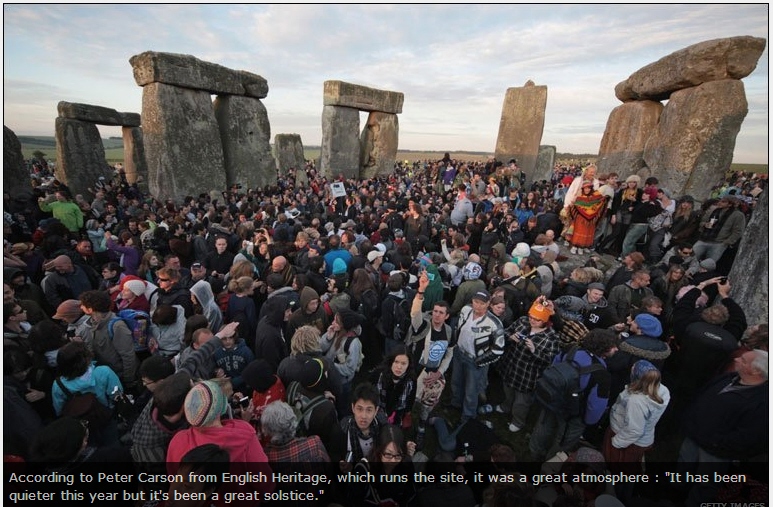 ALG celebrated this year’s Summer Solstice at Gaia’s Gardens in Raleigh NC. (not to be confused with the BBC photo of Stone Henge celebration pictured left)
 Awen's Light Grove
You must be logged in to post a comment.