CNN Blog Post — My Take: So who are the Druids, anyway?

Editor’s Note: Philip Carr-Gomm is a writer whose books include What Do Druids Believe? and The Book of English Magic and Wild Wisdom Meditations.

By Philip Carr-Gomm, Special to CNN

The Druids have hit the headlines in the recent days because religious charity status has been granted in the UK to The Druid Network – a group set up to foster Druid values and projects.

This has caused excitement in a number of circles. Many Druids and pagans see this as a major triumph. Others are upset because they don’t think Druidry is a religion, they feel it is a philosophy or a way of life.

And it’s worked at least one journalist into a frazzle. In The Daily Mail, Melanie Phillips revealed her disrespect and ignorance for many cultures and groups of people by writing such nonsense as “without the Judeo-Christian heritage there would be no morality and no true human rights,” in a column about Druids.

While one journalist is flustered, most are simply bemused because – they don’t really know much about the Druids.

I’ve  written books about Druidry and help to lead the world’s largest Druid group (The Order of Bards Ovates & Druids) so allow me to give a whistle-stop tour:

About three hundred years ago, a revival of interest in the pre-Christian religion of the Druids occurred in Britain, and this gave rise to three distinct movements.

One emerged out of the growing pride in the Welsh language, was entirely cultural, and involved the use of Druid ceremonial to dignify ‘Eisteddfodau’ – festivals of literature, music and performance.

The Archbishop of Canterbury, Rowan Williams, has been inducted as such an honorary Druid, as was Queen Elizabeth in 1946.

Another movement evolved as a form of fraternal association, akin to Freemasonry. At its height this Druid movement had over a million members spread across the Commonwealth and included Winston Churchill.

So much for Druidry being ‘weird’ – it has been part of mainstream British society for centuries.

The third kind of Druid to emerge has been the ‘spiritual’ or ‘religious’ druid, as opposed to the cultural or fraternal.

From the late 1980s this much smaller group of people has grown exponentially. The established religions were failing to speak to a new generation who longed for an approach that reverenced the Earth and Nature, and Druidry became at the turn of the century a ‘green religion’ that now has perhaps 50,000 or so followers around the world.

One of the intriguing aspects of Druidry, which gets even Druids confused and excited when they talk about it, is that it doesn’t behave in the way most religions behave. For starters, it combines effectively with other spiritual approaches: it’s non-exclusivist and universalist. I’ve met Christian Druids, Buddhist Druids and Hindu Druids.

It has no saviour figure, is light on dogma, and strong on ethical behaviour. Most religions have a magical seam running through them (if the eucharist isn’t magical I don’t what is).

But the established religions separated from both science and magic a long time ago, and relegate an interest in magic to the forbidden realm of ‘the occult’.  Druidry, by contras,t is an openly magical path – a spirituality that sees life as essentially magical and each of us as co-creators in this magic.

As such Druidry is not the recent invention of Romantics, New Agers, or Hippies, but stands in a long and historically linked line of magical schools that stretch back in time via the Victorian magicians of the Golden Dawn , the Cunning Folk of popular magic, the alchemists and Anglo-Saxon wizards to – yes – even the ancient Druids.

The opinions expressed in this commentary are solely those of Philip Carr-Gomm.

Deepening Our Spiritual Practice

I would like The Celtic New Yearto invite everyone in the Grove to join me in a ‘daily meditation’ study over the course of the next year. We’ll base it on Caitlin Matthews ‘The Celtic Spirit’ book, which provides daily, thought provoking meditation subjects for a solar cycle. We’ll start November 1 with the new Celtic New Year and we can discuss at our monthly meetups. You can pick up a copy at local book sellers or on Amazon.com

National Association of Earth Religions?

Most organizations collect together under an association to help manage public image, speak with one professional voice, lobby for rights and offers assistance with the media by pooling resources and a cohesive message.

Except for Earth Centered Religions.

This has become painfully apparent after the breaking news of Christine O’Donnell and her mis-characterizations of Wicca. Though I’m sure that the media has been deluged with thousands of  Wiccans reaching out (representing a small group of the estimated over 1 million in the Earth Centered religion population) the movement is lucky that the press didn’t go off on a tangent of just printing any retort that has most likely been sent to them.

Wicca has come a long way, battling against the slurs of ‘witch’ and other innocuous terms that are now levied in a tone of judgement, to the Pentagram symbol being an accepted on Arlington cemetery headstones for service members. The press for the most part is letting this die rather quickly and many interviews – even from her Democrat challenger, Chris Coons – said that the ‘revelation’ doesn’t matter.

But the question remains “is anyone really able to respond to this outrage for the community from any authority of representation”?

What do you think?

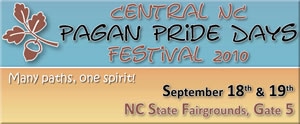
Central NC Pagan Pride Day September 18th and 19th

Central NC Pagan Pride Day is a chapter of the international Pagan Pride Project, a non-profit organization whose mission is to foster pride in Pagan identity, and to eliminate prejudice and discrimination based on religious beliefs, all through education, activism, charity and community.

Isaac Bonewits 1949 – 2010

Philip Emmons Isaac Bonewits, founder and Archdruid Emeritus of of Ár nDraíocht Féin: A Druid Fellowship, one of North America’s leading experts on ancient and modern Druidism, Witchcraft, magic and the occult, and the rapidly growing Earth Religions movement, died today after a short struggle with cancer.

Mr. Bonewits first came into the public eye when he graduated from the University of California at Berkeley with a Bachelor of Arts in Magic and Thaumaturgy (1970). During his tenure there, Mr. Bonewits worked with many renowned professors including Nobel Prize Laureate Owen Chamberlain. The work he did for that degree became his first book, Real Magic: An Introductory Treatise on the Basic Principles of Yellow Magic (1971).

In 1983, he founded and became the first Archdruid of Ár nDraíocht Féin: A Druid Fellowship (ADF) an international fellowship devoted to creating a public tradition of Neopagan Druidry. In 1995, he retired from a leadership role due to complications from eosinophilia-myalgia syndrome. ADF has grown to become the best-known Neopagan Druid group based in North America. At his death, Mr. Bonewits held the title of ArchDruid Emeritus.

During his forty years as a Neopagan priest, scholar, teacher, bard, and polytheologian, Isaac Bonewits coined much of the vocabulary and articulated many of the issues that have shaped the rapidly growing Neopagan movement in the United States and Canada.

Mr. Bonewits was internationally known as a speaker who educated, enlightened and entertained two generations of modern Goddess worshippers, nature mystics, and followers of other minority belief systems, as well as explained these movements to journalists, law enforcement officers, college students, and academic researchers.

His personal papers will become part of the American Religions Collection at the Library of University of California at Santa Barbara.

One of his most influential contributions was the Advanced Bonewits Cult Danger Evaluation Frame (the “ABCDEF”), developed in 1979 as a response to the Jim Jones People’s Temple tragedy. It has been translated into many languages and used around the world to evaluate how dangerous or harmless an organization might be. It was the first such scale to use theories of mental health and personal growth to judge rather than theological or ideological standards.

His other books include Authentic Thaumaturgy (1979, 1998), The Pagan Man (2005), Bonewits’s Essential Guide to Witchcraft and Wicca (2006), Bonewits’s Essential Guide to Druidism (2006), Neopagan Rites (2007), and Real Energy (2007), which was co-authored with his wife, Phaedra, as well as numerous articles, reviews and essays. As a singer-songwriter, he released two albums, Be Pagan Once Again (1988), and Avalon is Rising (1992).

He is survived by his wife, Phaedra, his son from a previous marriage, Arthur Lipp-Bonewits of Bardonia NY, his mother Jeannette, his brothers Michael and Richard, and sisters Simone Arris and Melissa Banbury.